Sampling Distributions I


Megan Ayers

Math 141 | Spring 2026
Friday, Week 5

Announcements/Reminders

  • New member of the course assistant team
  • Updated office hours
  • HW 4 due today
  • Extra time for HW 5: due Monday March 9
  • Final exam slots finalized
  • Reminder to pick up your learning assessment for feedback

Goals for Today

  • Start learning the foundations of inference

  • Perform a group sampling activity

  • Discuss random sampling: the heart of statistics!

Distinguishing between the population and the sample

\[ y = \beta_0 + \beta_1 x_1 + \beta_2x_2 + \ldots + \beta_p x_p + \epsilon \]

  • Parameters:
    • Based on the population
    • Unknown then if don’t have data on the whole population
    • EX: \(\beta_0\), \(\beta_1\), \(\ldots\), \(\beta_p\)

\[ \widehat{y} = \widehat{ \beta}_0 + \widehat{\beta}_1 x_1 + \widehat{\beta}_2 x_2 + \ldots + \widehat{\beta}_p x_p \]

  • Statistics:
    • Based on the sample data
    • Known
    • Usually estimate a population parameter
    • EX: \(\widehat{\beta}_0\), \(\widehat{\beta}_1\), \(\ldots\), \(\widehat{\beta}_p\)

General Definitions: Parameters and Statistics

  • Parameter: Numerical characteristic of a population (e.g., average of a variable in a population)

  • Statistic: Estimate of the population parameter using the sample (e.g., average of the same variable in the sample)

  • Researchers often wish to investigate the value of a parameter in a population.

    • The proportion of U.S. voters who plan to vote for a particular presidential candidate.
    • The mean life-time earnings for Reed college graduates
  • But it is often not feasible to collect complete information on the population.

  • Instead, researchers collect a sample and measure a statistic, which estimates the population parameter

    • The proportion of voters in a sample of size 500 who plan to vote for the candidate.
    • The mean life-time earnings for 100 randomly chosen Reed graduates.

Sampling Activity

Decks of cards

If we count:

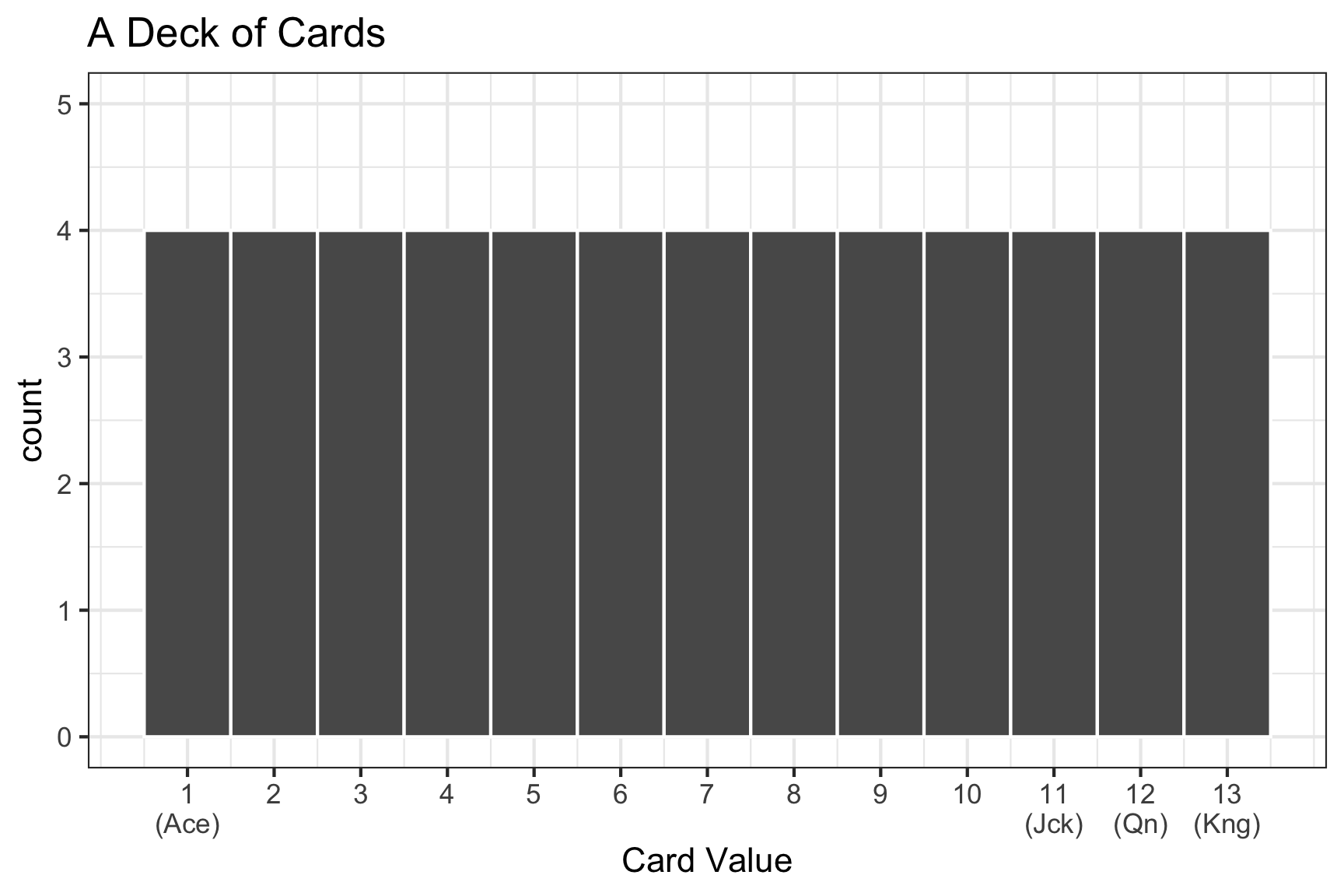
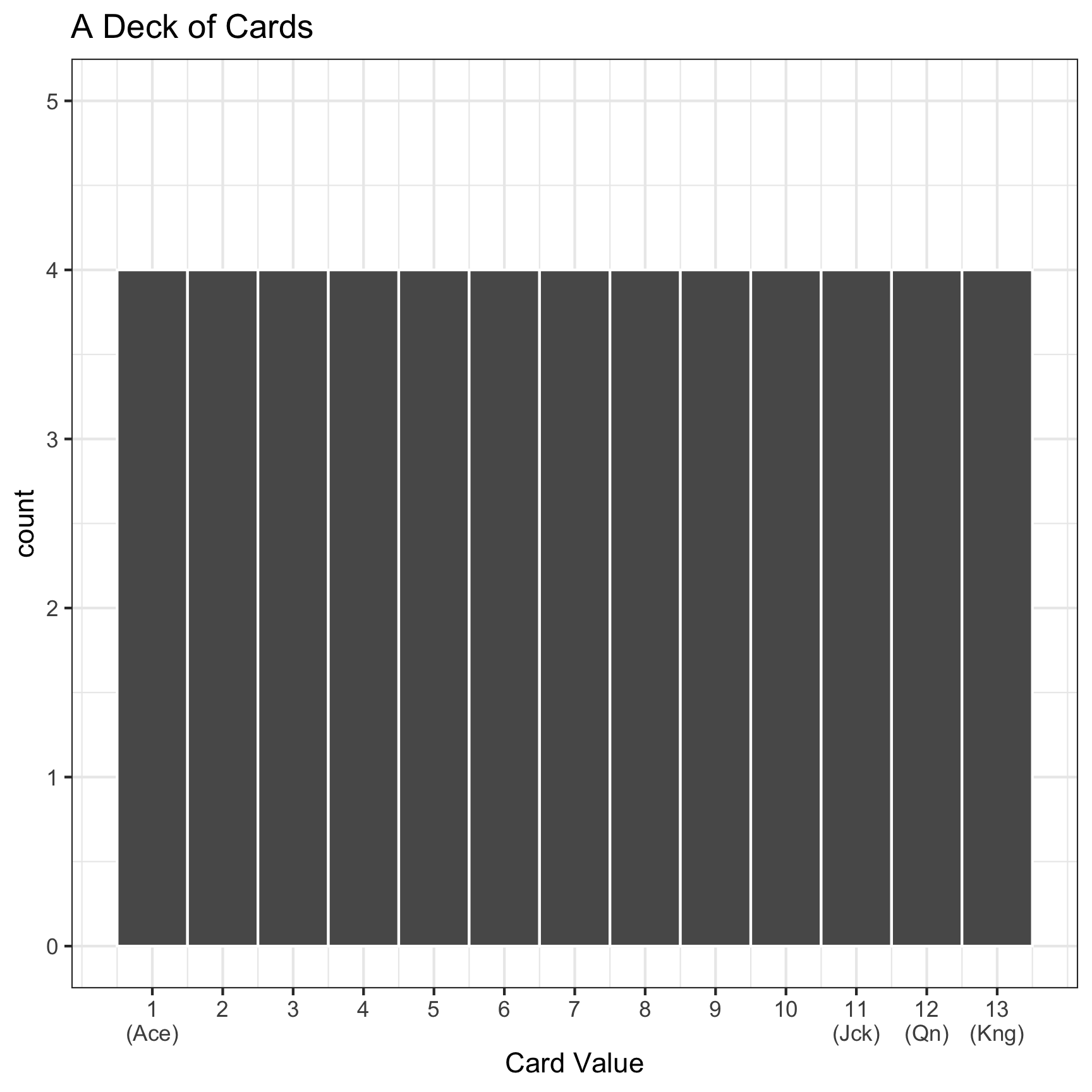
  • Aces as 1
  • Jacks as 11
  • Queens as 12
  • Kings as 13

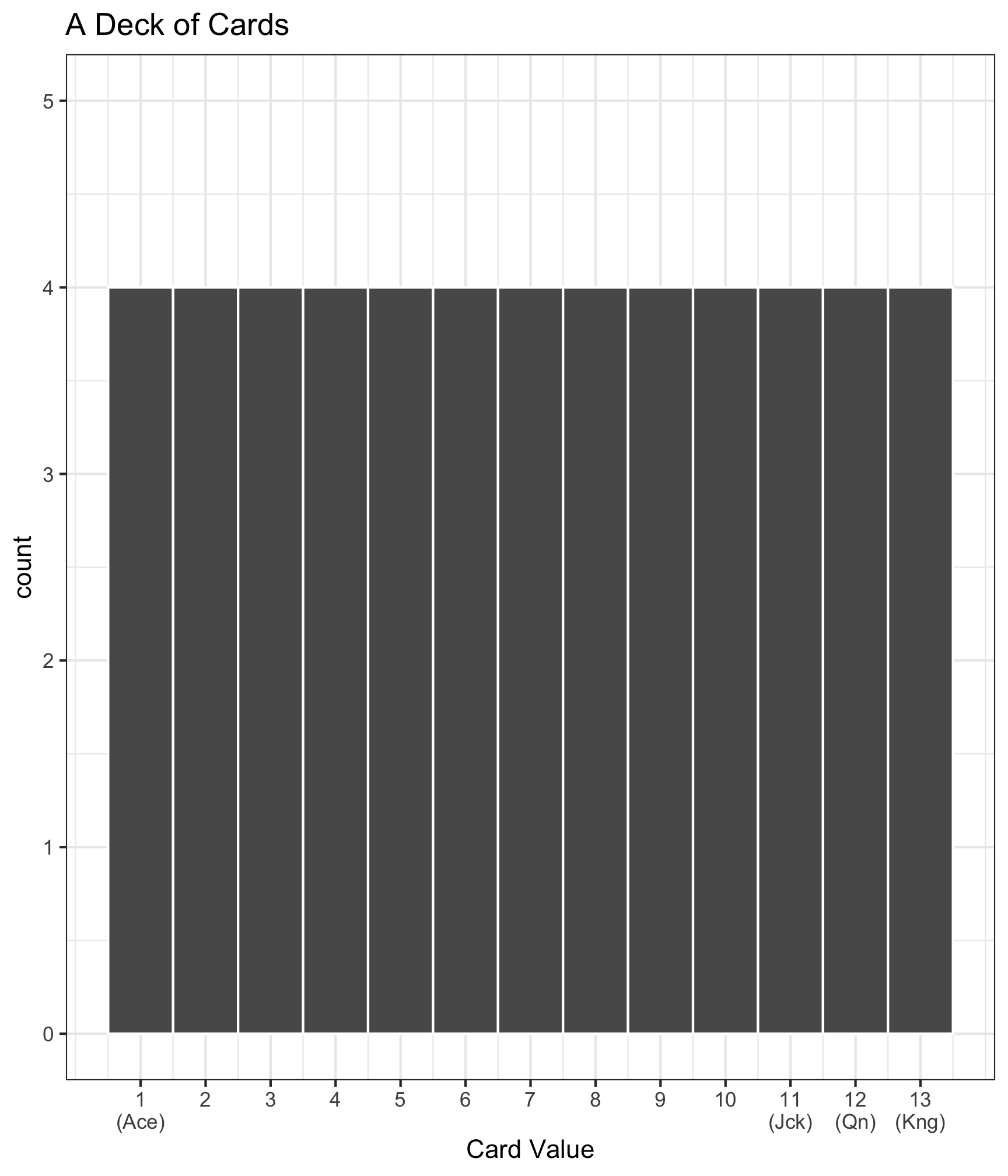
The distribution of numbers in a deck of cards looks like:

Drawing cards: Population, Sample, Parameter, and Statistic

  • Today, we’re going to be:
    • Randomly drawing 10 cards from a deck of cards
    • Calculating the average value of our 10 cards


  • Q: What is the sample? What is the population?
  • Q: What is the statistic? What is the parameter?
Activity Instructions

  1. Thoroughly shuffle your group’s deck of cards.
  2. Draw 10 cards from the deck to form a sample.
  3. Compute the average/mean value of your 10 cards
  4. Write the value of the average/mean on a sticky note and add to chalkboard.
  5. Repeat steps 1 - 4 an additional four times.

Each group should have calculated 5 averages from 5 different samples of 10 cards!

Small Group Discussion

Once you’re done, discuss the following questions with your group:

  1. What is the true average card value in a deck of cards?
  2. How does the distribution of sample means compare to the distribution of card values in a deck of cards?
  3. What is the relationship between the centers of the two distributions?
  4. Which distribution appears to have more variability?
  5. How do the shapes of the two distributions compare? Why do they differ?
Discussion

  1. What is the true average card value in a deck of cards?
  2. How does the distribution of sample means compare to the distribution of card values in a deck of cards?
  3. What is the relationship between the centers of the two distributions?
  4. Which distribution appears to have more variability?
  5. How do the shapes of the two distributions compare? Why do they differ?

Sampling Overview

Sampling Overview

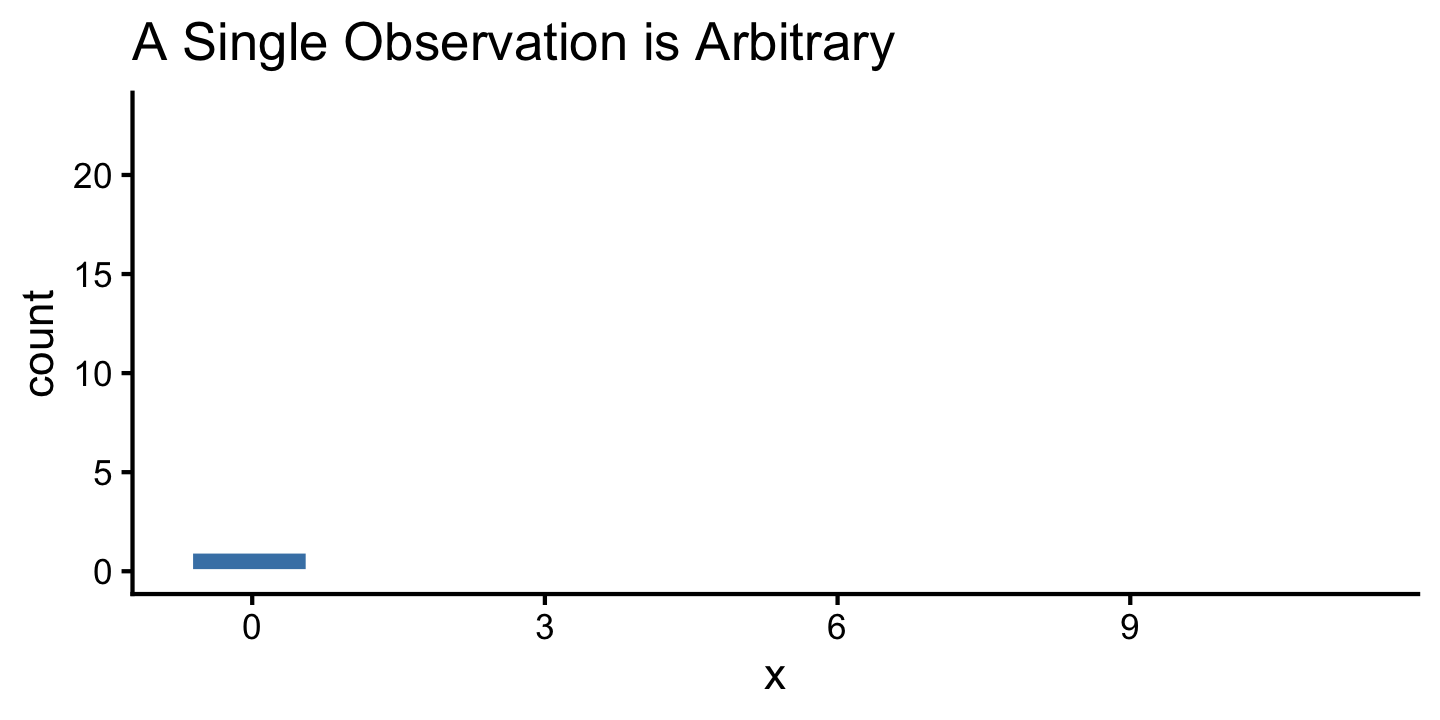
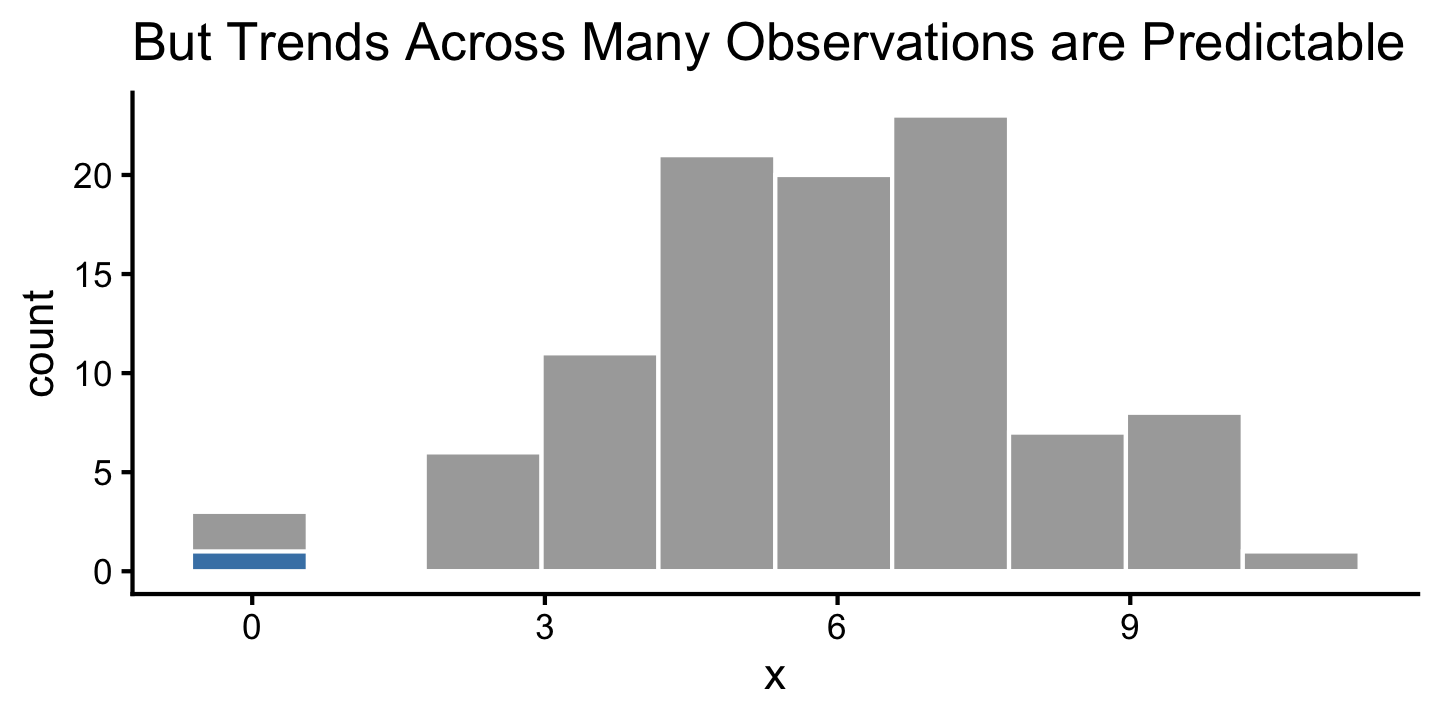
  • The distribution of a data set allows us to quantify the shape, center, and spread of the data.
  • While a single observation in a data set may appear arbitrary… repeated trials often show that outcomes follow certain patterns.
Sampling Overview

  • The distribution of a data set allows us to quantify the shape, center, and spread of the data.
  • While a single observation in a data set may appear arbitrary… repeated trials often show that outcomes follow certain patterns.
Sampling Overview

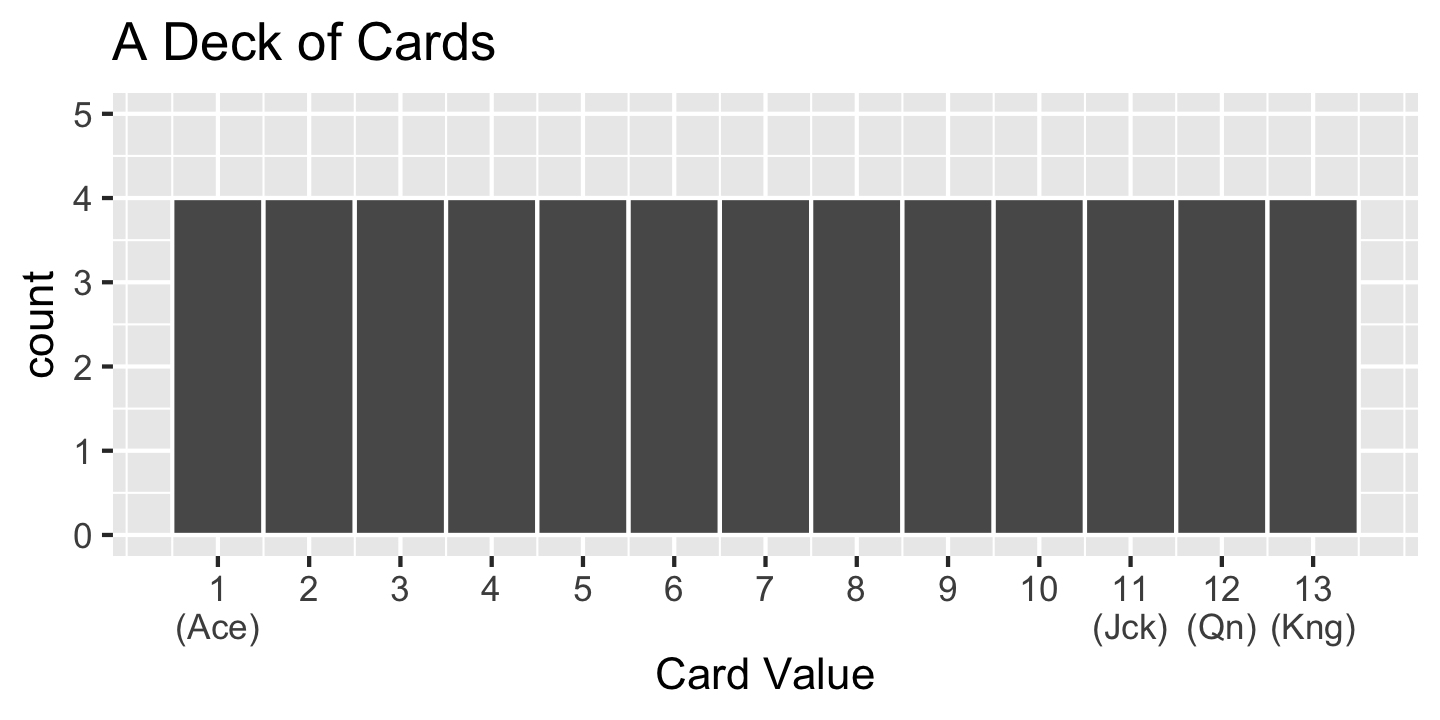
  • We know that a variable from a population has a distribution
    • e.g., the distribution of card values in a deck of cards
  • Moral of Today: Statistics (e.g., mean of variable in a sample) have distributions too!!
    • How? We only have ONE statistic – the statistic from the ONE sample we drew
    • Distribution is over all the possible samples we could have drawn (we just see 1)
  • Implication: Statistics themselves have a mean, standard deviation, 5-number summary
    • The mean tells us the statistic’s typical value in a randomly chosen sample.
    • The standard deviation tells us how the statistic fluctuates from sample to sample.
  • Very Powerful: e.g., Can use this distribution to give plausible ranges for the parameter and a sense of uncertainty in a given statistic.

Bigger Picture - Quantifying Our Uncertainty

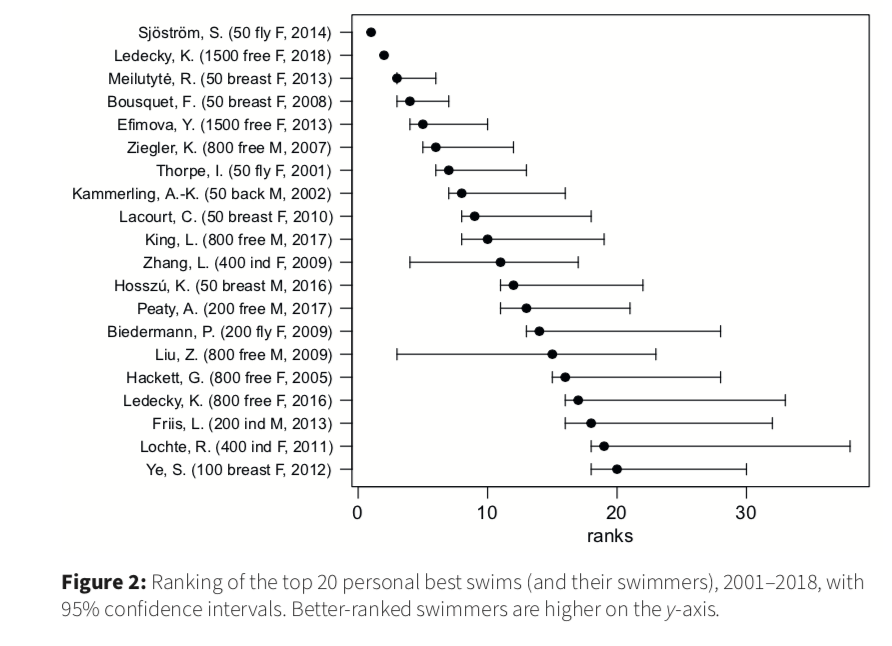
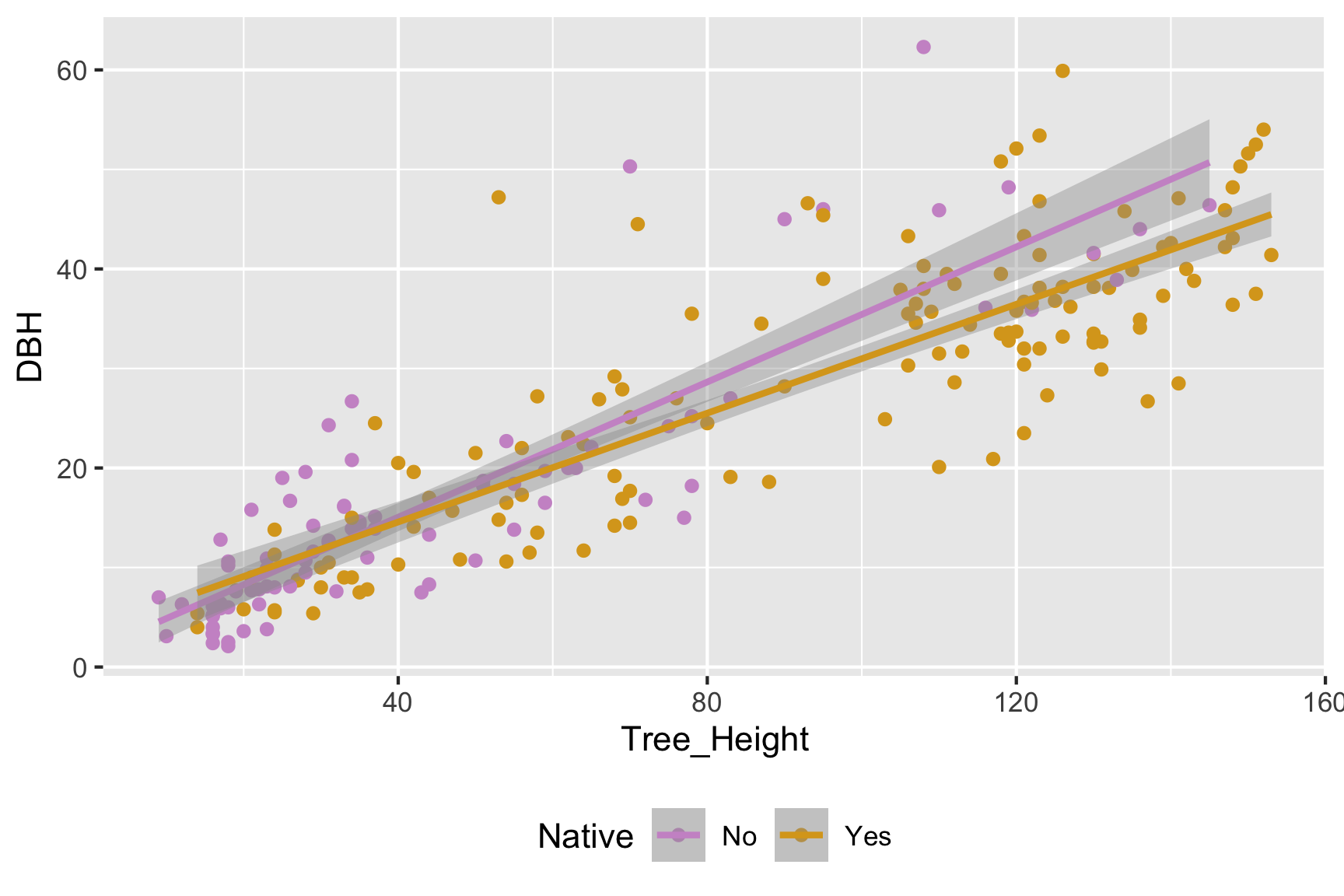
R has been giving us uncertainty estimates (ex. geom_smooth when we don’t set se = FALSE):
Bigger Picture - Quantifying Our Uncertainty

R has been giving us uncertainty estimates (ex. std_error in summaries from lm()):

# A tibble: 4 × 7
  term          estimate std_error statistic p_value lower_ci upper_ci
  <chr>            <dbl>     <dbl>     <dbl>   <dbl>    <dbl>    <dbl>
1 intercept        7.39      3.65       2.03   0.044    0.201   14.6  
2 DBH              2.25      0.17      13.3    0        1.92     2.59 
3 Native: Yes     11.1       5.59       1.98   0.049    0.067   22.1  
4 DBH:NativeYes    0.315     0.215      1.47   0.144   -0.108    0.739

Bigger Picture - Quantifying Our Uncertainty in Statistics

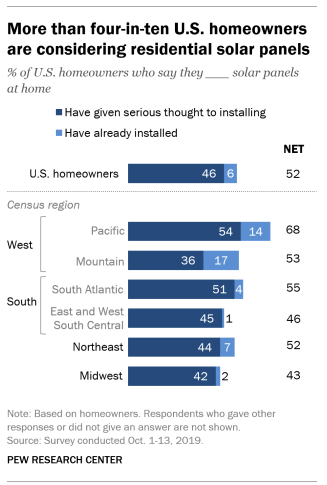
Uncertainty estimates are constantly reported in news and journal articles:
Bigger Picture - Quantifying Our Uncertainty in Statistics

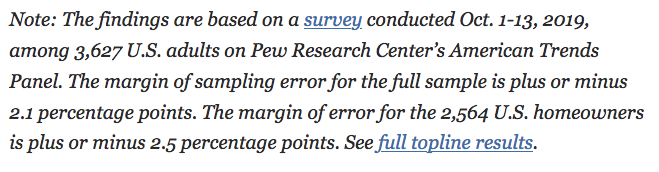
Uncertainty estimates are constantly reported in news and journal articles:
Statistical Inference

  • Goal: Draw conclusions about the population based on the sample.
    • We’ve seen how to calculate a statistic from our sample
    • But different samples give different statistics: how do we know whether to trust the one we have?
    • Sampling distributions show how widely our statistic can range across samples
    • This helps us understand how much to trust any single statistic