Linear Models V
Megan Ayers
Math 141 | Spring 2026
Wednesday, Week 5
Model Form:
\[ \begin{align} y &= \beta_0 + \beta_1 x_1 + \beta_2 x_2 + \cdots + \beta_p x_p + \epsilon \end{align} \]
Linear regression is a flexible class of models that allow for:
Both quantitative and categorical explanatory variables.
Multiple explanatory variables.
Transformed explanatory variables.
BUT the response variable is quantitative.
palmerpenguins!
One Quantitative Variable
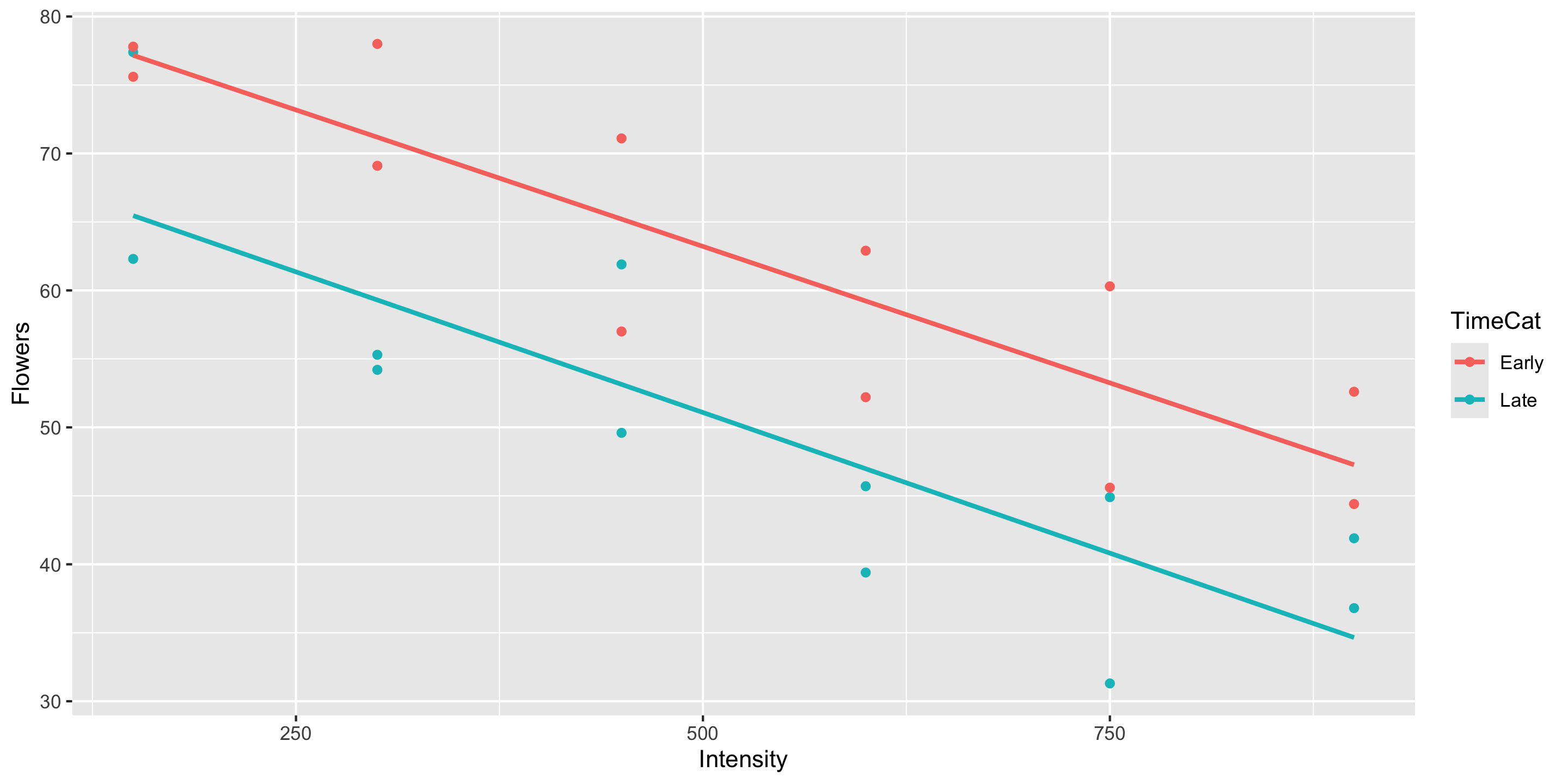
Equal Slopes Model
Different Slopes Model
# A tibble: 6 × 2
term estimate
<chr> <dbl>
1 intercept 23.1
2 species: Chinstrap -9.64
3 species: Gentoo -5.84
4 bill_depth_mm 0.857
5 species: Chinstrap:bill_depth_mm 1.06
6 species: Gentoo:bill_depth_mm 1.16
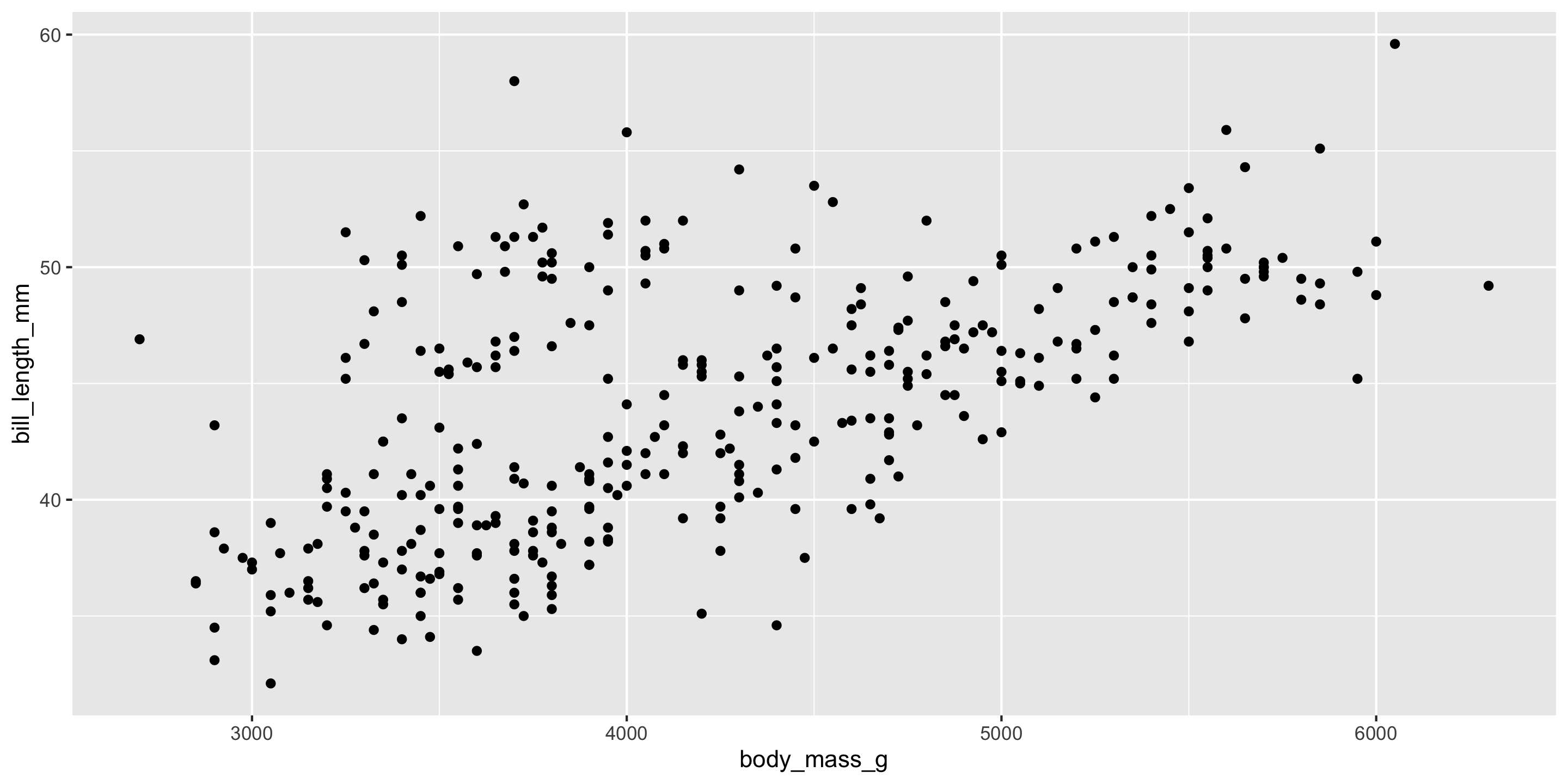
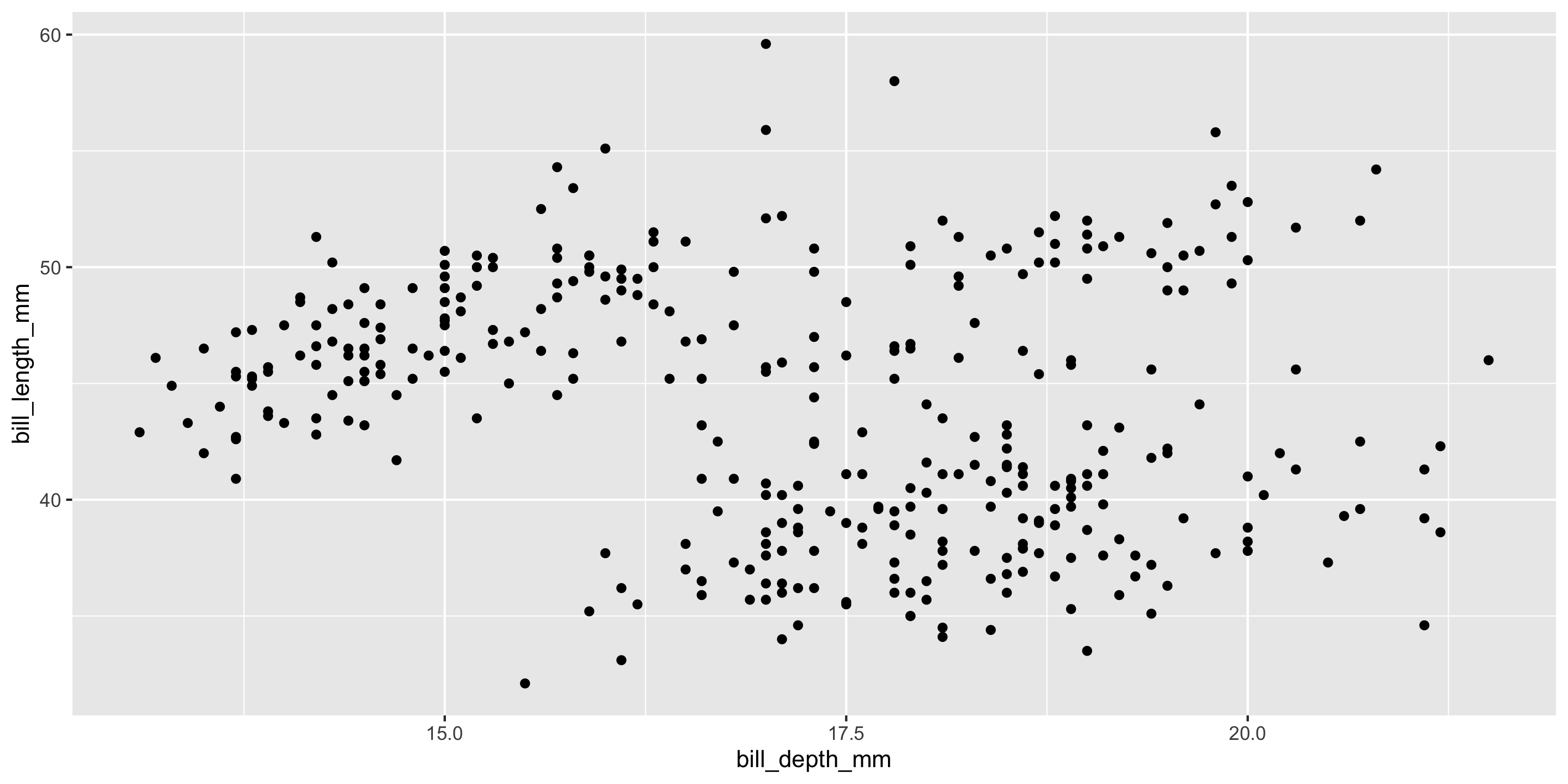
\[ y = \beta_0 + \beta_1x_{\textrm{Bill Depth}} + \beta_2 x_{\textrm{Body Mass}} + \epsilon \]
In R:
# A tibble: 3 × 7
term estimate std_error statistic p_value lower_ci upper_ci
<chr> <dbl> <dbl> <dbl> <dbl> <dbl> <dbl>
1 intercept 23.3 3.27 7.14 0 16.9 29.7
2 bill_depth_mm 0.163 0.137 1.19 0.234 -0.106 0.432
3 body_mass_g 0.004 0 12.6 0 0.004 0.005
Should we always include an interaction term? How many variables should I include?
Guiding Principle: Occam’s Razor for Modeling
“All other things being equal, simpler models are to be preferred over complex ones.” – ModernDive
Guiding Principle: Consider your modeling goals.

We often have several potential explanatory variables. How do we determine which to include in the model and in what form?
Guiding Principle: Include explanatory variables that attempt to explain different aspects of the variation in the response variable.
library(tidyverse)
library(moderndive)
movies <- read_csv("https://www.lock5stat.com/datasets2e/HollywoodMovies.csv")
# Restrict our attention to dramas, horrors, and actions
movies2 <- movies %>%
filter(Genre %in% c("Drama", "Horror", "Action")) %>%
drop_na(Genre, AudienceScore, RottenTomatoes)
glimpse(movies2)Rows: 313
Columns: 16
$ Movie <chr> "Spider-Man 3", "Transformers", "Pirates of the Carib…
$ LeadStudio <chr> "Sony", "Paramount", "Disney", "Warner Bros", "Warner…
$ RottenTomatoes <dbl> 61, 57, 45, 60, 20, 79, 35, 28, 41, 71, 95, 42, 18, 2…
$ AudienceScore <dbl> 54, 89, 74, 90, 68, 86, 55, 56, 81, 52, 84, 55, 70, 6…
$ Story <chr> "Metamorphosis", "Monster Force", "Rescue", "Sacrific…
$ Genre <chr> "Action", "Action", "Action", "Action", "Action", "Ac…
$ TheatersOpenWeek <dbl> 4252, 4011, 4362, 3103, 3778, 3408, 3959, 3619, 2911,…
$ OpeningWeekend <dbl> 151.1, 70.5, 114.7, 70.9, 49.1, 33.4, 58.0, 45.3, 19.…
$ BOAvgOpenWeekend <dbl> 35540, 17577, 26302, 22844, 12996, 9791, 14663, 12541…
$ DomesticGross <dbl> 336.53, 319.25, 309.42, 210.61, 140.13, 134.53, 131.9…
$ ForeignGross <dbl> 554.34, 390.46, 654.00, 245.45, 117.90, 249.00, 157.1…
$ WorldGross <dbl> 890.87, 709.71, 963.42, 456.07, 258.02, 383.53, 289.0…
$ Budget <dbl> 258.0, 150.0, 300.0, 65.0, 140.0, 110.0, 130.0, 110.0…
$ Profitability <dbl> 345.30, 473.14, 321.14, 701.64, 184.30, 348.66, 222.3…
$ OpenProfit <dbl> 58.57, 47.00, 38.23, 109.08, 35.07, 30.36, 44.62, 41.…
$ Year <dbl> 2007, 2007, 2007, 2007, 2007, 2007, 2007, 2007, 2007,…

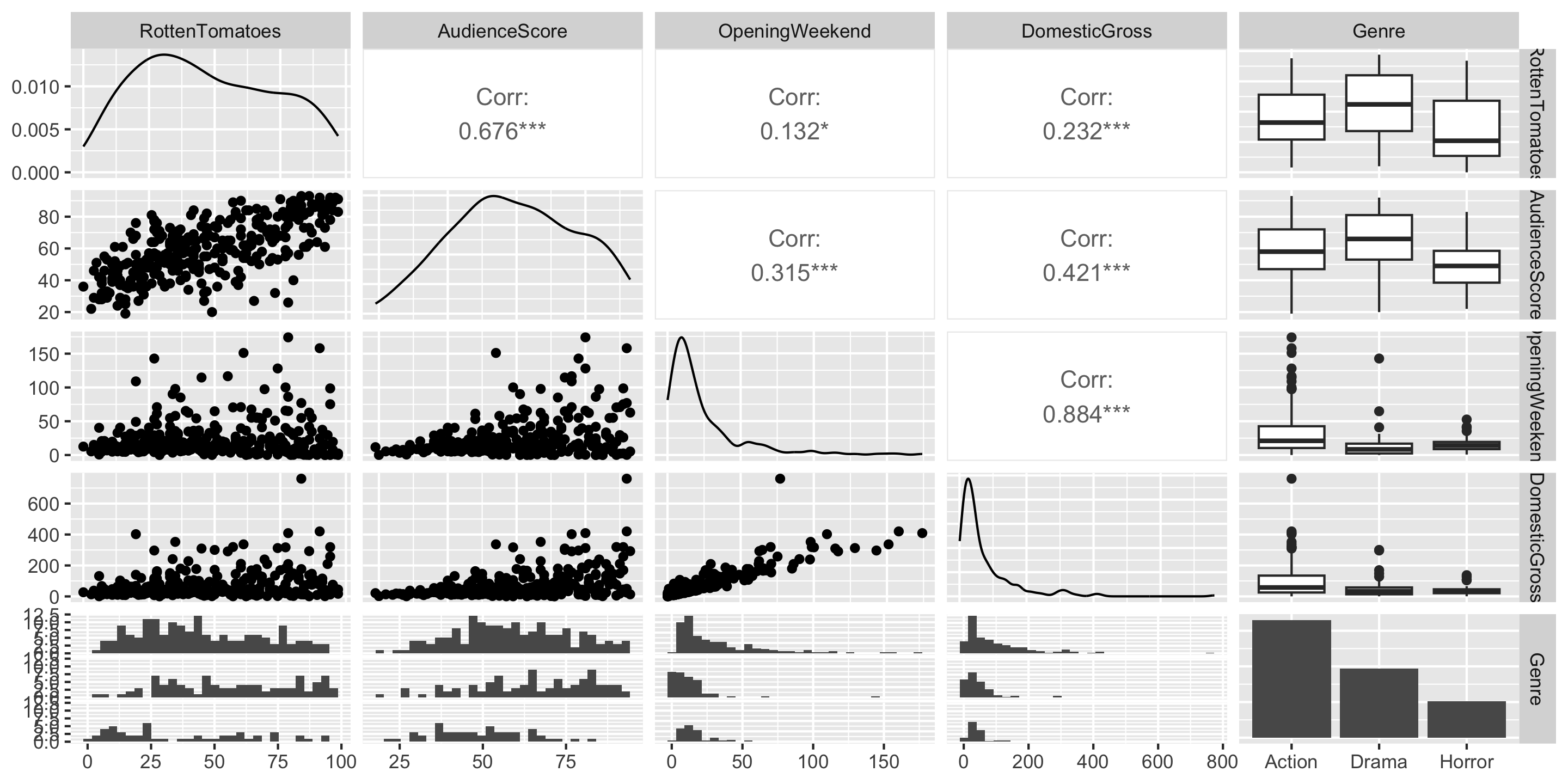
Multicollinearity: when explanatory variables are highly correlated with one another. Multicollinearity often results in coefficients that are distorted in erroneous ways!
Q: Do any of these variables seem to be measuring the same thing?
We often have several potential explanatory variables. How do we determine which to include in the model and in what form?
Guiding Principle: Include explanatory variables that attempt to explain different aspects of the variation in the response variable.
# A tibble: 5 × 7
term estimate std_error statistic p_value lower_ci upper_ci
<chr> <dbl> <dbl> <dbl> <dbl> <dbl> <dbl>
1 intercept -12.5 4.08 -3.06 0.002 -20.5 -4.44
2 AudienceScore 0.975 0.072 13.6 0 0.834 1.12
3 Genre: Drama 6.12 2.64 2.31 0.021 0.916 11.3
4 Genre: Horror 2.06 3.14 0.655 0.513 -4.12 8.24
5 DomesticGross -0.006 0.015 -0.431 0.667 -0.035 0.023
What degree of polynomial should I include in my model?
Guiding Principle: Capture the general trend, not the noise.
\[ \begin{align} y &= f(x) + \epsilon \\ y &= \mbox{TREND} + \mbox{NOISE} \end{align} \]
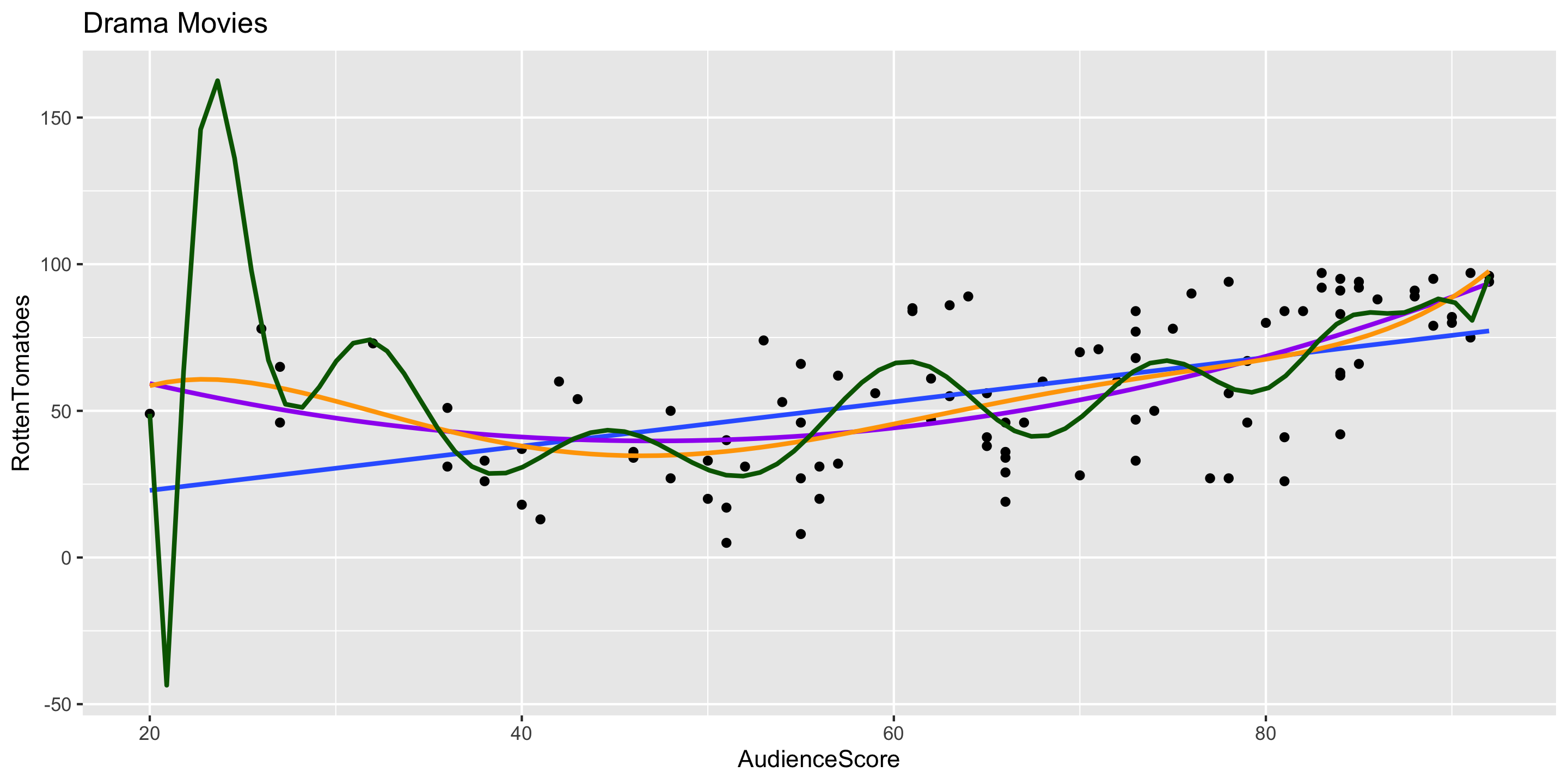
Suppose I built 3 different models. Which is best?
Big question! Take Math 243: Statistical Learning to learn systematic model selection techniques.
We will explore one approach. (But there are many possible approaches!)
Strategy: Compute the \(R^2\) value for each model and pick the one with the highest \(R^2\).
# A tibble: 1 × 1
r_squared
<dbl>
1 0.457
# A tibble: 1 × 1
r_squared
<dbl>
1 0.469
# A tibble: 1 × 1
r_squared
<dbl>
1 0.469
Strategy: Compute the \(R^2\) value for each model and pick the one with the highest \(R^2\).
# A tibble: 1 × 1
r_squared
<dbl>
1 0.457
# A tibble: 1 × 1
r_squared
<dbl>
1 0.469
# A tibble: 1 × 1
r_squared
<dbl>
1 0.469
Problem: As we add predictors, the \(R^2\) value will only increase.
Guiding Principle: Occam’s Razor for Modeling
“All other things being equal, simpler models are to be preferred over complex ones.” – ModernDive
New Measure of quality: Adjusted \(R^2\) (Coefficient of Determination)
\[\begin{align*} \mbox{adj} R^2 &= 1- \frac{\sum (y - \widehat{y})^2}{\sum (y - \bar{y})^2} \left(\frac{n - 1}{n - p - 1} \right) \end{align*}\]
where \(p\) is the number of explanatory variables in the model.
Now we will penalize larger models.
Strategy: Compute the adjusted \(R^2\) value for each model and pick the one with the highest adjusted \(R^2\).
# A tibble: 1 × 2
r_squared adj_r_squared
<dbl> <dbl>
1 0.457 0.455
# A tibble: 1 × 2
r_squared adj_r_squared
<dbl> <dbl>
1 0.469 0.464
# A tibble: 1 × 2
r_squared adj_r_squared
<dbl> <dbl>
1 0.469 0.462
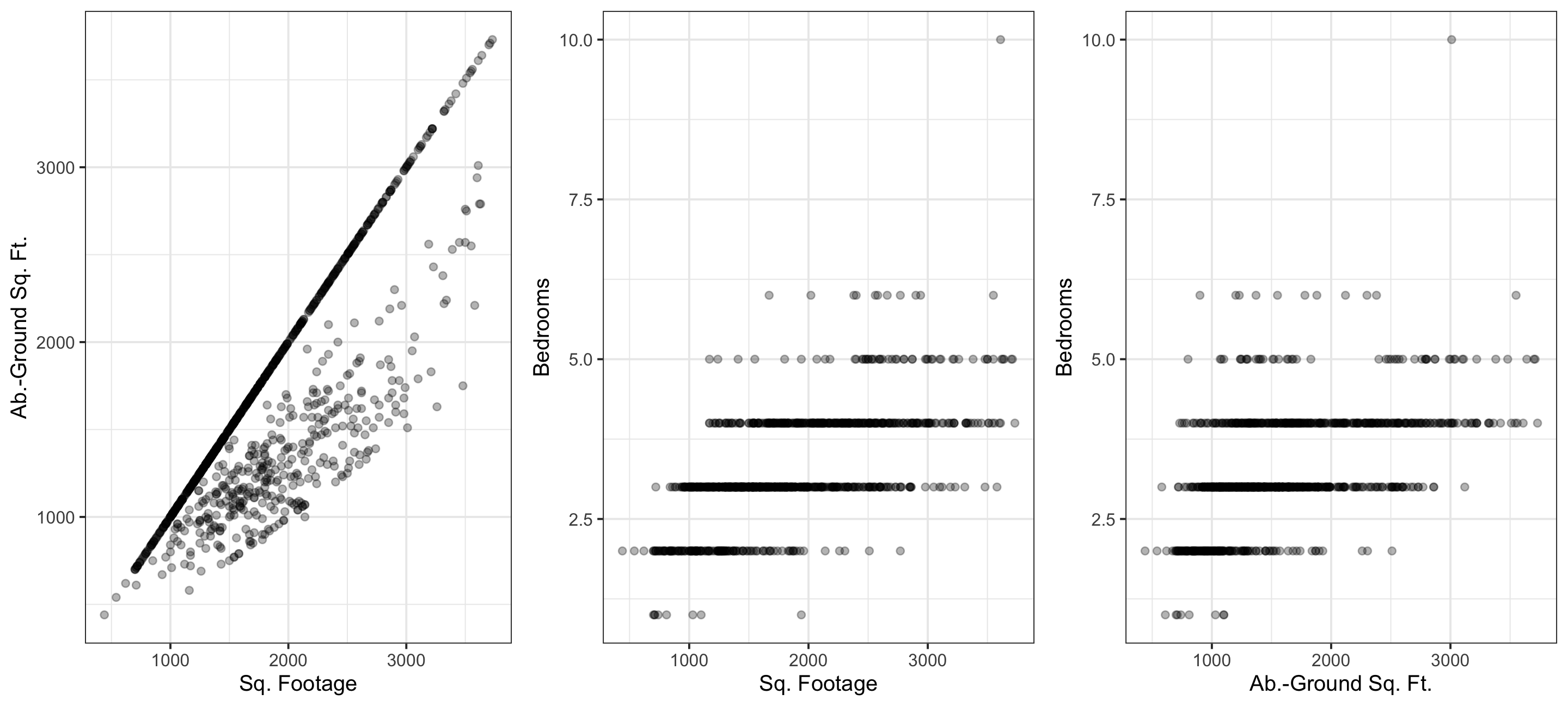
We’ll consider : Sale price (response); and square footage, above-ground square footage, and number of bedrooms (potential explanatory variables). Check out the exploratory plots below:
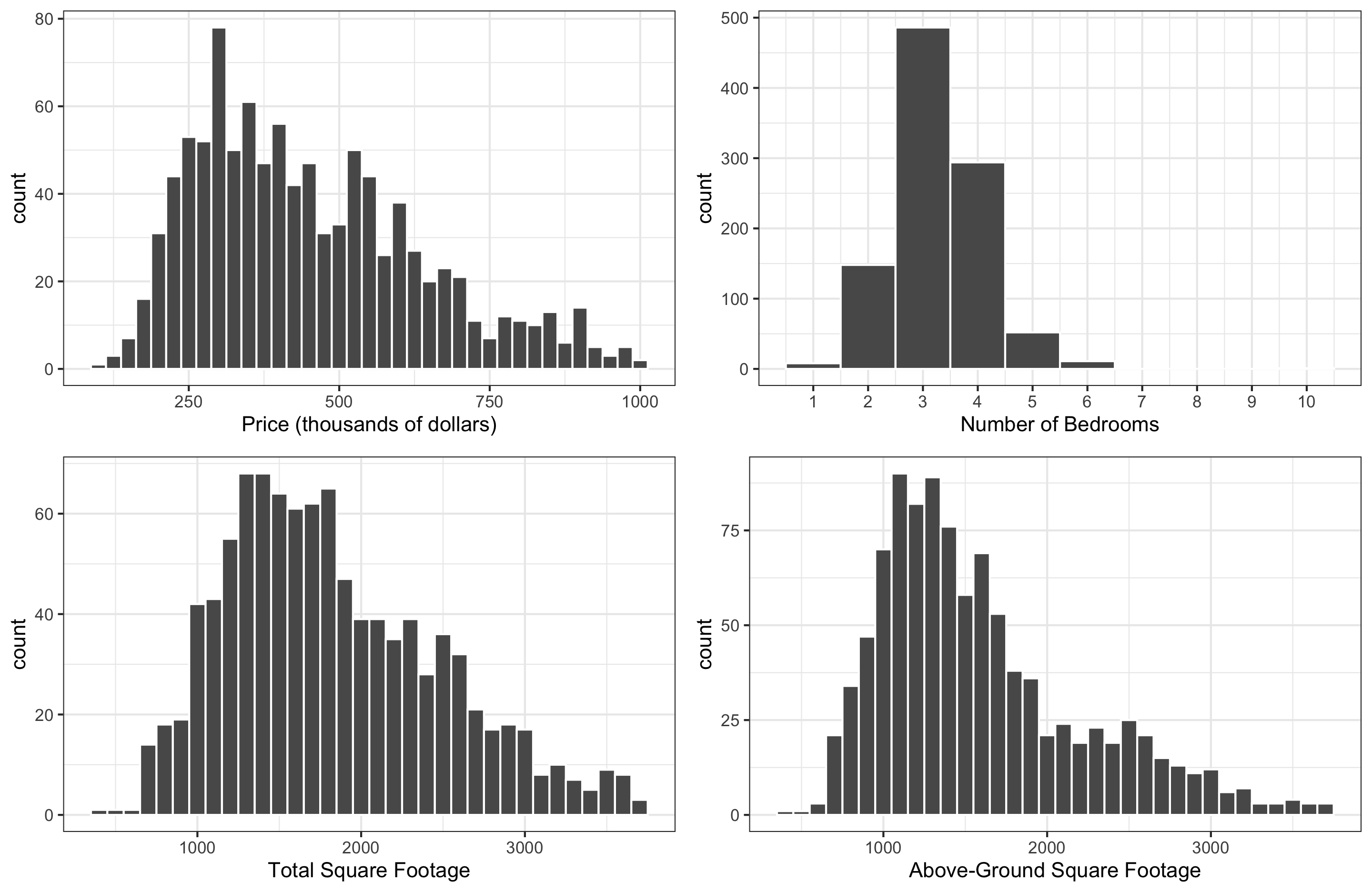
Q: How would you describe the distribution of price?
Q: What do you expect the relationship between price and bedrooms to be like?

Multicollinearity: when explanatory variables are highly correlated with one another. Multicollinearity often results in coefficients that are distorted in erroneous ways! We want to avoid this (some correlation is okay!)
Q: Which pair of explanatory variables suffers most from multicollinearity?
# A tibble: 3 × 7
term estimate std_error statistic p_value lower_ci upper_ci
<chr> <dbl> <dbl> <dbl> <dbl> <dbl> <dbl>
1 intercept 197. 19.4 10.1 0 159. 235.
2 sqft_living 0.177 0.01 18.4 0 0.158 0.196
3 bedrooms -21.6 7.27 -2.97 0.003 -35.9 -7.34
\[ \widehat{\text{price}} = 197 + 0.177*\text{sqrt_living} - 21.6*\text{bedrooms} \]
sqrt_living and bedrooms are both 0, we expect/predict price to be $197,000 on average.bedrooms increases by 1, we expect/predict price to decrease by $21,600 on average, holding sqft_living constant.
What’s the adjusted \(R^2\) of our model?
# A tibble: 1 × 2
r_squared adj_r_squared
<dbl> <dbl>
1 0.314 0.313
Not super close to 1. Compare to a simpler model:
Compare to a much bigger model with additional variables:
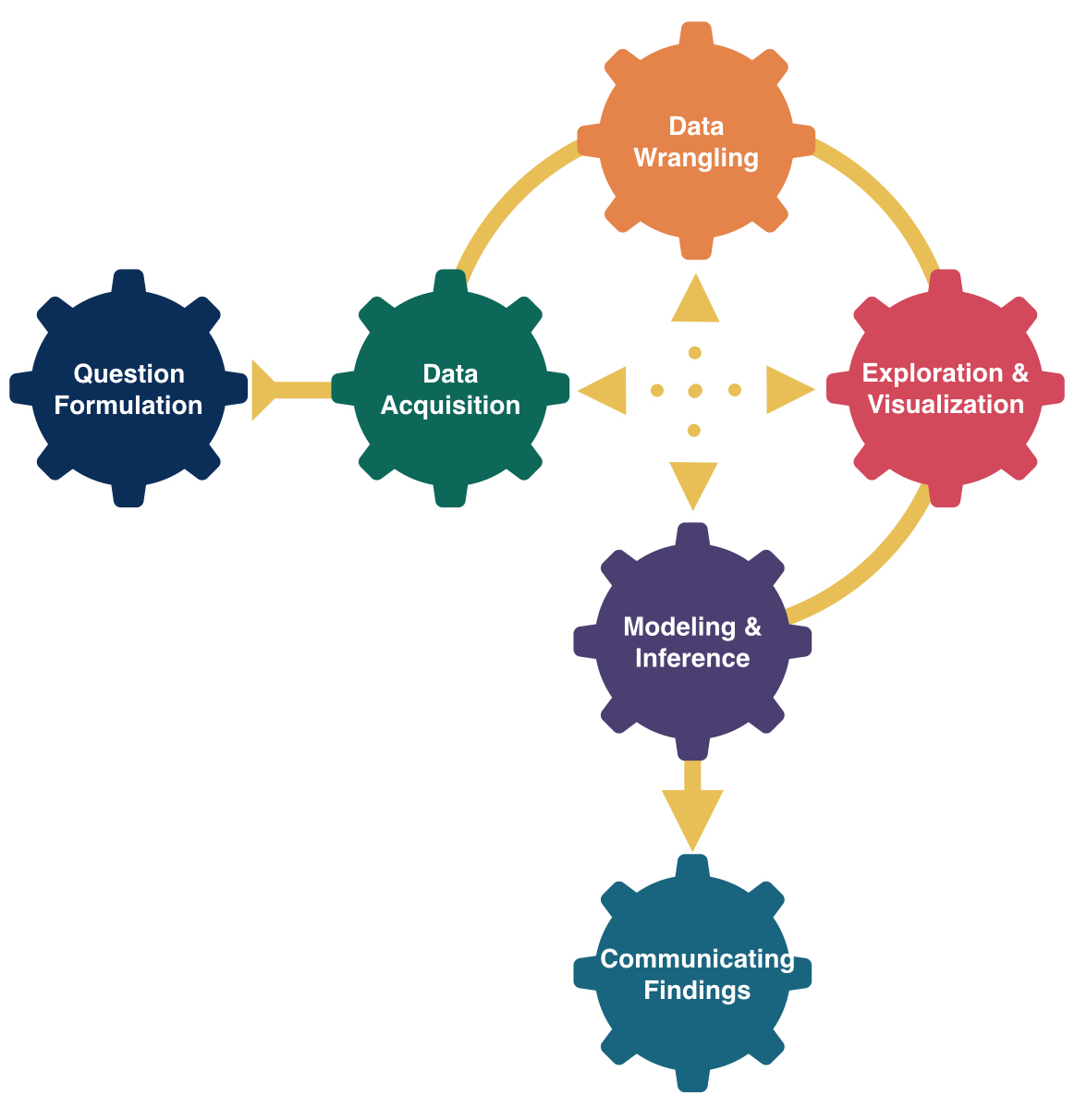
Key components that we’ve learned about over the last 5 lectures:
R